

Online stores · Home & lifestyle

Meta ads for online home and lifestyle stores

Home shoppers ask two questions: will it fit, and will it go with what I have? So a homewares or lifestyle store's Meta ads work when the creative shows true scale and colour, one offer lifts the order, the delivery cost in the cart matches the ad, bulky pieces only run where you can deliver them fairly, and you judge it all on MER, store revenue divided by total ad spend, not Meta's ROAS alone. Your Off Retainer plan sets each piece from your own numbers.

Free quiz and diagnosis. Personalised plan A$149 incl. GST. For stores on Shopify, WooCommerce, BigCommerce, Wix, Squarespace and Neto/Maropost.

A vase of dried flowers, a linen cushion, a brass candlestick and a navy bowl on a sideboard.

The free diagnosis

Why your ads aren’t delivering

The quiz checks your answers against the usual causes for online home & lifestyle stores and marks the ones that apply to you. These come up most.

A store owner at a desk in a small studio, looking over a chart on a laptop.
  • The delivery cost ambushes them at checkout

    Meta did its job: the shopper clicked and added to cart. Then a freight charge the ad never mentioned appears, and the sale dies. Your plan shows delivery costs before checkout and runs bulky pieces only where you can deliver at a fair price.

  • Your ads can't show how big it is

    A side table in a small square could be any size, and "smaller than I thought" is a return. Your plan's shot list puts a person or a familiar object beside the product, then the dimensions on a card.

  • Your small orders lose money

    A single candle or mug rarely pays for the ad that sold it once delivery and fees come out. Your plan works out your break-even cost per purchase and picks an offer that lifts the order.

  • Your catalogue shows the wrong picture

    Colourways sharing one image, a room shot where the product is hard to spot, sizes with no dimensions. In a catalogue ad, that image is the ad. Your plan sets which image leads.

  • Meta's ROAS is counting sales you'd have got anyway

    Retargeting and broad campaigns reach people already on their way to buy. Meta's ROAS climbs and your store revenue doesn't. Your plan measures MER first: store revenue divided by total ad spend.

How home shoppers decide
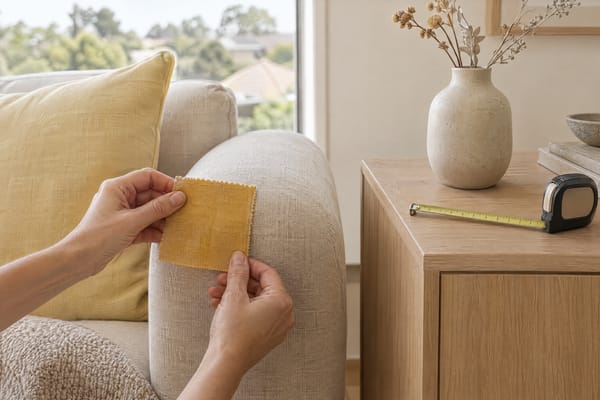
A linen swatch held against a sofa, with a tape measure on the sideboard.
  • Two questions: will it fit, and will it go with what I have? Dimensions, scale and true colour decide the sale.
  • Big pieces are slow decisions. Shoppers visit several times, compare and measure. Delivery cost and lead time often decide it at checkout.
  • Small pieces are quick buys and frequent gifts: candles, kitchenware, prints, cushions.
  • Quality is judged by material. Linen weight, solid timber or veneer, glaze, wax, paper. Name it and show it up close.

What Meta does well for homewares, and what it does badly

Meta is good at room inspiration that stops the scroll, at carousels that show a whole look, at reminding people over the weeks a big purchase takes, and at gift peaks for small pieces.

It’s bad at showing scale in a small square, at selling a large piece in one visit, and at surviving a delivery-cost surprise at checkout. Its automatic enhancements can also brighten your images until natural linen looks bleached. Your plan’s weekly check starts with MER, your store’s revenue divided by your total ad spend. Meta’s ROAS comes second, for comparing ads.

Read more: ROAS vs MER, explained, and what to check when Advantage+ isn’t working.

Offers that work for home and lifestyle stores

  1. Delivery included over a threshold just above your average order. For bulky pieces, flat-rate metro delivery is often the offer that matters most.
  2. Bundles and sets: a full bedding set, a candle trio, a cookware set, the whole look.
  3. Swatches or samples for fabric, linen and rugs. They remove the fear of the wrong colour.
  4. Gift sets and gift boxes for candles, kitchenware and small décor.
  5. A trial period for bedding, toppers or chairs, only if it’s real and the terms are on the page.

Your plan picks one for your store and uses it in every ad. It skips “was” prices you never really charged, sales that never end, and delivery promises with exceptions buried at checkout.

Rules your home and lifestyle ads must follow

  • Was/now prices must be genuine. False sale prices have drawn some of the largest recent penalties against online stores.
  • “Sitewide” means the whole site. A sale with exclusions isn’t sitewide.
  • Delivery claims must match the cart. Show delivery costs before checkout, with any conditions beside the claim.
  • Some products carry mandatory safety standards. Tall furniture needs tip-over warnings (the rules also cover hall tables, buffets and sideboards 686 mm or taller, and entertainment units of any height), button-battery products need secure compartments and warnings, candles with lead wicks and candle holders that can catch fire are banned, and corded blinds, bean bags and electrical goods have rules of their own. Check before you list.
  • Material and size claims need proof. “Solid timber” only when it isn’t veneer; linen and organic claims only with supplier proof.

Your plan covers these rules in full for your sub-type. It’s general information, not legal advice.

Other plans

Also for online home & lifestyle stores

The same free quiz checks these too, and says whether they fit your numbers before you pay.

  • Available

    Google Ads plan

    Google Shopping first, then Performance Max once your store reaches about 30 sales a month from it. Searches for your brand are kept in their own small campaign, so you can see what Google really adds.

    About the Google Ads plan
  • Available

    ChatGPT ads test plan

    Available. Your plan checks your tracking, current ads and budget first, and says wait if one isn’t ready.

    About the ChatGPT ads test plan

Real results

From real accounts

A homewares store that set a delivery threshold, a store that fixed its offer before adding spend, and a homewares store on Google Shopping. The last is a Google Ads result. Its lesson carries over to Meta: a higher order value gives you room on cost per purchase, so judge your ads on order value and orders in your own store.

From a client's account

A free-delivery threshold

A client's homewares store set a free-delivery threshold and kept ad spend flat.

A free-delivery threshold: Before compared with After
BeforeAfter
Ad spend A$5,070A$5,070
Average order value A$99A$126
Purchases 127147
Cost per purchase A$39.92A$34.49
ROAS 2.48x3.65x
Free delivery has a cost: the subsidy comes out of the margin on every qualifying order.
From a client's account

Fixing the offer before adding spend

A client's online store improved its offer and kept Meta spend exactly the same.

Fixing the offer before adding spend: Before compared with After
BeforeAfter
Meta spend A$5,660A$5,660
Average order value A$85A$104
Purchases 156182
Cost per purchase A$36.28A$31.10
MER (store revenue ÷ ad spend) 3.85x4.87x
From a client's account · Google Ads

Homewares through Google Shopping

A client's homewares store ran Google Shopping.

Homewares through Google Shopping: Before compared with After
BeforeAfter
Spend A$8,890A$9,540
Purchases 183219
Average order value A$153A$163
Cost per purchase A$48.58A$43.56
ROAS 3.15x3.74x

From client accounts and our own venues and online brands, anonymised. Individual results vary. Results disclaimer

Questions

Online home & lifestyle stores: common questions

Do Facebook ads work for homewares stores?

They work when the creative shows true scale and colour, one offer lifts the order, the cart honours the ad's delivery promise, and your break-even maths includes delivery. Ads can't fix a freight charge that appears at checkout or a page with no dimensions, so your plan checks those first. Nobody can promise results, and we don't.

Should I offer free delivery in my ads?

A delivery threshold just above your average order often lifts order value, but the subsidy comes out of your margin on every qualifying order. Work it into your break-even before you set it, and make sure the cart says exactly what the ad says.

How do I advertise furniture and other bulky items?

Give them their own product set and advertise them only where you can deliver at a fair price. Big pieces take several visits, so your plan sets a longer retargeting window and judges them over weeks, not days.

Do I count Google Shopping when I measure my Meta ads?

Yes. MER is your store's revenue divided by your total ad spend, Google included, so it shows whether your advertising as a whole pays. Use Meta's own ROAS to compare Meta ads with each other, not to decide whether the spend is worth it.

How much time does it take each week?

About 30 minutes a week once the one-off setup (2–3 hours) is done, plus an hour every second week making new ads. For homewares, that hour is mostly room shots, texture close-ups and a slow pan across a styled space.

Find out what’s holding your ads back.

Three minutes, free, and the diagnosis is worked out from your own answers. Your full plan is A$149 incl. GST if you want it.

Take the free 3-minute quiz

Free quiz and check-up. No card needed. Questions? Email us.